


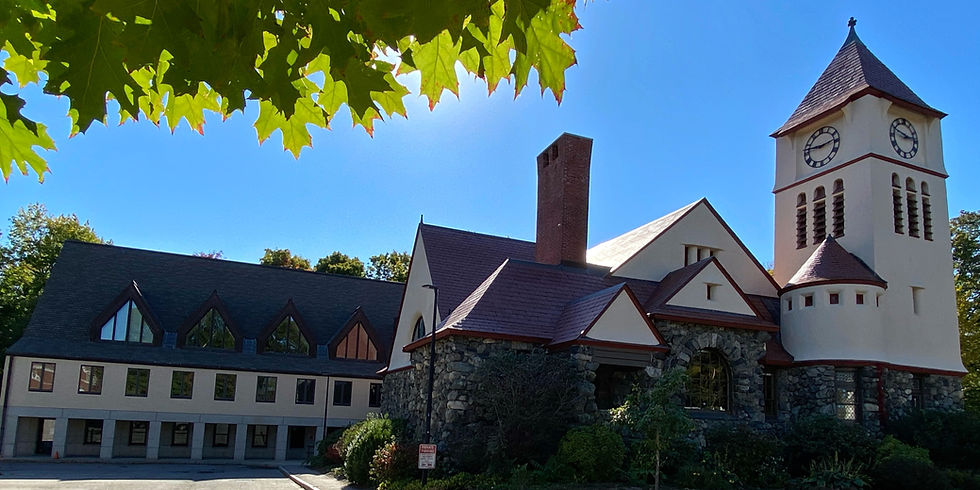
Our Building
We are located at 404 Concord Ave., Belmont, MA 02478
Drop-in office hours: Monday, Wednesday, and Friday, 10:00 am–1:00 pm.
Additional availability by appointment, Monday–Friday.
The office is closed for all state and federal holidays.
Accessibility
We welcome and affirm people of all abilities. We have taken the following steps to assure that no one is excluded for full participation in the life of our congregation*. Please contact us if we can be of further assistance.
-
Our building is fully accessible, with an elevator that provides access to all congregant levels and ramps at all entrances.
-
Hearing devices are available for use in the sanctuary.
-
Large print bulletins are available during Sunday morning worship. Please ask any usher for assistance.
Children and Adults With Special Needs
If you want your child to participate in the religious education program and feel that they may require special accommodation due to learning disabilities or behavioral issues, please contact Assistant Minister for Lifespan Faith Formation, Rev. Martha Durkee-Neuman in advance so the best possible arrangements can be made: mdneum@uubelmont.org.
The First Church in Belmont welcomes adults who are neurodiverse or have special challenges.
Pastoral Care
We provide pastoral care to all members and attendees regardless of ability. If you have a hidden disability that you think it’s important for someone to know, please contact Rev. Martha or Rev. Chris to share your information in confidence.
*We are aware that we can still do more to be more accessible and welcome your suggestions.
Green Sanctuary
The First Church Belmont, UU, embraces the Green Sanctuary goals mapped out by the Unitarian Universalist Association. For example, when the church underwent a major renovation of the Parish Hall, the new construction was LEED certified. We work to advance climate justice and implement sustainability initiatives within the church and commit to four practices, grounded in Unitarian Universalist principles:
-
Environmental Justice: We partner with marginalized communities who are hit first and hardest by environmental crises. By partnering with these communities, we can address human and environmental needs simultaneously.
-
Worship and Celebration: As we work together toward a cleaner, more just and sustainable world, worship inspires our work and reminds us of what is most sacred and most true.
-
Religious Education: Our workshops and programs for all ages shape attitudes and build practices that are sustainable and spiritually-grounded.
-
Sustainable Living: We treat the world more gently by using fewer resources and being mindful of the choices we make, both as a congregation and as households.
Learn more about the FCB Green Committee’s work.
Building History
The physical space at 404 Concord Avenue in Belmont, MA has shaped our community since 1890.
The church’s initial home, built in 1857, was where the Post Office sits today on Concord Ave. It was a simple “carpenter gothic” building next to the railroad that also served as a library and gathering spot for town meetings in the early days.
When fire razed that building in April 1890, plans were already well underway for a new church home. Today’s beautiful First Church sanctuary was completed and dedicated in April 1890.
Famed Boston architects Hartwell and Richardson designed the new church (they also designed the Belmont Town Hall in 1881). Church members donated stones from their fields for the building's base. The building’s signature is the rare, red slate roof. The tower clock was a gift from the town.
The building consisted of the Sanctuary, the Ladies’ Parlor (now the Minister’s Study), the connecting Sunday School Room (now called the Parlor), and the Minister’s Study (which became the Church Office). Beneath the study was a small kitchen with a dumbwaiter for sending food up for church socials.
The rainbow-shaped stained-glass window in the chancel was designed by the artist Will H. Low and executed in Louis Tiffany’s studio in New York.
Since then, the church has undergone several periods of dramatic growth and change. A new parish house in 1924 expanded the physical space and included a Parish Hall with a balcony, a kitchen, restrooms, and six classrooms.
In 1929 the church completed a major remodeling of the sanctuary, including a new organ, choir loft, pulpit, and electrification—the sanctuary had been illuminated by gas lamps until that time.
The architect was church member H. Thaxter Underwood. At the time, it was said that “as a result of these alterations, the First Church now has one of the finest organs and most beautiful church interiors to be found in the neighborhood of Boston.”
For the church’s centennial in 1956, a capital campaign was launched to refurbish the church building, create usable classroom and gathering space, and add the covered porch entrance on our west façade.
The church purchased the wooded parcel behind the Johnson House in 1960. Intended for additional parking, it was turned into a playground. The Johnson House itself was purchased from the estate of church member Miss Rachel Johnson in 1968.
Several capital campaigns over the years helped improve and sustain the facilities, from basic renovations to the repair and maintenance of the red slate roof. In 1994, the organ was re-leathered, and a sprinkler system was installed, among other enhancements.
Our church has also served as a haven for those in need. In 1986, during the Iran-Contra scandal, a Sanctuary Committee was formed and provided information on El Salvador and its refugees. On February 28, 1988, the congregation voted to “declare ourselves a Sanctuary for Central American Refugees.”
The most significant change to our church facilities began in 2000, with a major capital campaign to dramatically expand the building. The architectural firm of Robert Olson + Associates was retained to design the new building. The construction created a fully accessible parish hall with a new stage and educational wing and refurbished the lower level of the 1890 building for staff office space. The new building was dedicated in November 2004, addressing decades of space needs.
Today, our physical space continues to provide the backbone for our community—though some activities moved online during the COVID-19 pandemic, and services are now broadcast for those at home. For more than 165 years, the First Church Belmont, UU, congregation has adapted and supported the physical church structure as our community home, a sanctuary, and gathering place.
You can find a detailed history of the church beyond the physical structure, on the Church History page.